
Large Format Landscape Photography at Cley-next-the-Sea
Winter has a way of stripping a landscape back to its essentials. At Cley-next-the-Sea, on the North Norfolk coast, that reduction feels particularly complete. The salt marshes flatten, colour drains to muted greys and ochres, and the sky becomes the dominant presence — not dramatic in the conventional sense, but quietly expansive and deeply absorbing. It’s the ideal time of year for 4×5 large format landscape photography.
This artwork, “The Last Light of Winter”, was made during one of those magical winter afternoons when the marshes seem to hold their breath. It is an image shaped by patience rather than urgency, observation rather than abundance — qualities that sit at the very core of large format landscape photography.
Rather than just presenting the photograph as a static frame alone, I chose to create it as an interactive high resolution zoomable image, allowing viewers to explore the landscape slowly, revealing both visual detail and context over time. This interactive, zoomable photograph allows viewers to explore the exceptional detail of this large-format winter landscape at Cley-next-the-Sea.
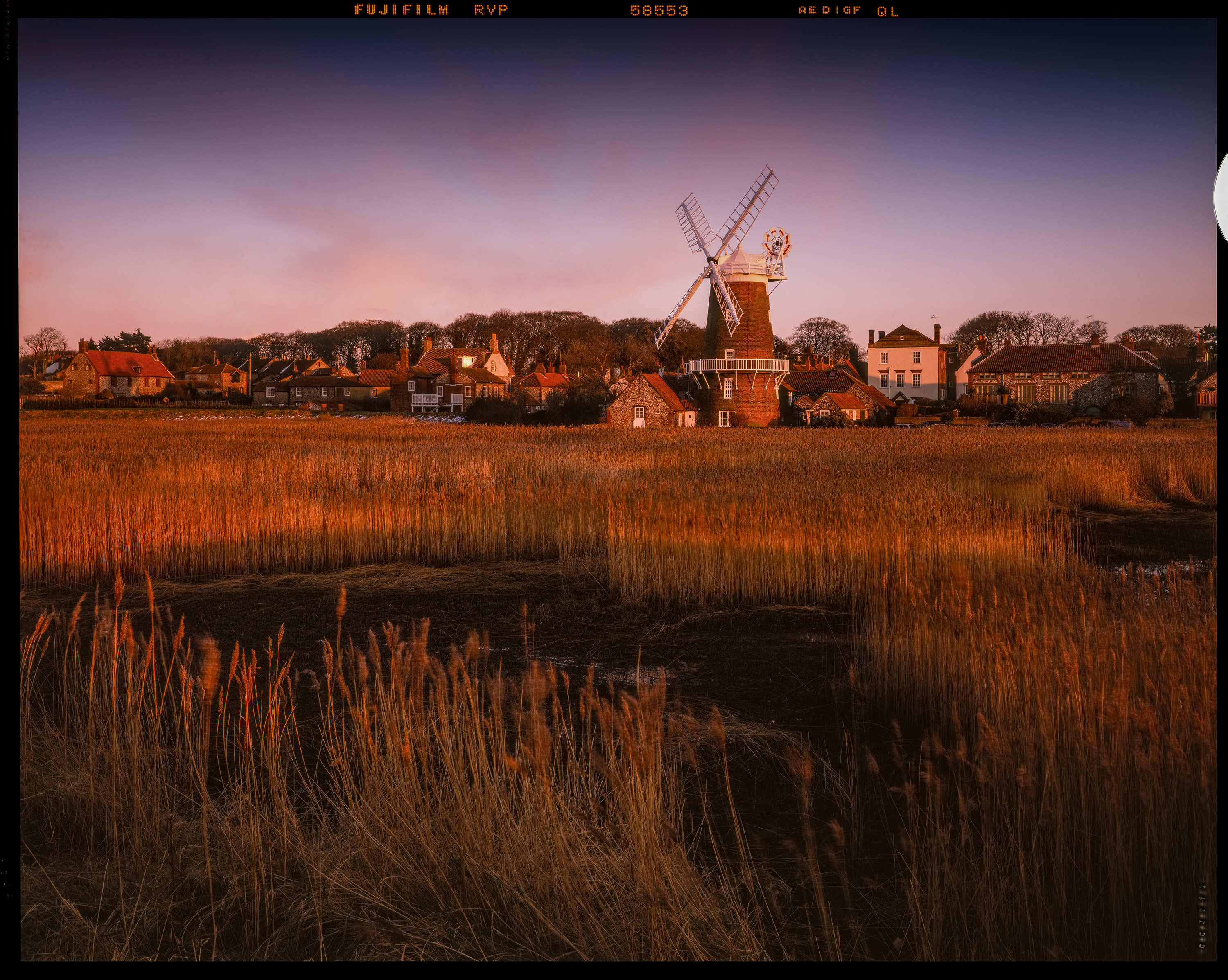
“The last light of Winter” – Cley-next-the-Sea, Norfolk, England. 4×5 large format landscape photography. © Rod Edwards 2026.
Cley-next-the-Sea in Winter
Cley is often associated with summer light and wide open skies, but winter offers something more restrained and introspective. With fewer visitors and little movement, the marshes become quieter, their structure more visible. Reeds cut back for traditional thatching reveal subtle rhythms in the land, and the reduced colour palette places greater emphasis on tone, balance, and light.
It is precisely this type of environment that suits 4×5 large format landscape photography. When nothing is hurried, the photographer is free to respond carefully to what the landscape offers — and just as importantly, to what it withholds.
Large format film and unrivalled image detail
This image was photographed on 4×5 inch large format transparency film, a medium that still offers unparalleled resolution, tonal subtlety, and micro-detail. The physical size of the film allows for an extraordinary amount of visual information to be recorded — far beyond what is typically captured by smaller digital sensors. Because of this, the image can be comfortably enlarged ten times or more, producing exhibition-quality prints of 40 × 50 inches (100cm x 125cm @ 300dpi) and beyond, without loss of clarity, texture, or presence. Fine details in the reeds, subtle gradations in the sky, and the quiet separation between land and water remain intact even at very large scales. This format, and use of traditional film emulsion materials, makes this image not just an artwork, but an ephemeral moment captured in time that transcends modern digital imagery.
Large format film is particularly well suited to:
- Enormous wall prints
- Gallery installations
- Architectural spaces
- Murals and statement artworks
To get a taste of this wealth of detail, make sure you zoom in on screen as you interact with the image.
Film vs digital in fine art photography
While digital photography excels in speed and convenience, large format film operates on an entirely different philosophy. Each sheet of film represents a single, deliberate exposure. There is no repetition, no safety net, and no automation to dilute decision-making. Film is a traditional craft, and the analogue beauty captures a look and feel far less clinical than digital pixels.
As a fine art medium, 4×5 film offers:
- A distinctive tonal character that is difficult to replicate digitally
- A slower, more intentional working method
- A physical original that was actually present at the moment of capture
- A clear separation from mass-produced digital imagery
This approach results in photographs that are not only visually distinctive, but also inherently rarer and more valuable. In an era dominated by infinite digital replication, this rarity matters. It makes the work unique, more considered, and more collectable.
Limited edition fine art prints, photographs and artwork
“The Last Light of Winter” is available as a limited edition fine art artwork, produced to museum-quality standards and tailored to the space it will inhabit.
Prints are available on a wide range of surfaces, including:
- Archival fine art papers
- Contemporary matte and gloss finishes
- Aluminium and modern display substrates
- Custom presentation formats for large spaces
Each work of art is carefully produced, signed, and editioned, ensuring long-term value and consistency across the series.
If you are interested in acquiring this artwork, commissioning a large-scale print, or discussing a specific installation or custom surface, please get in touch via the contact page:
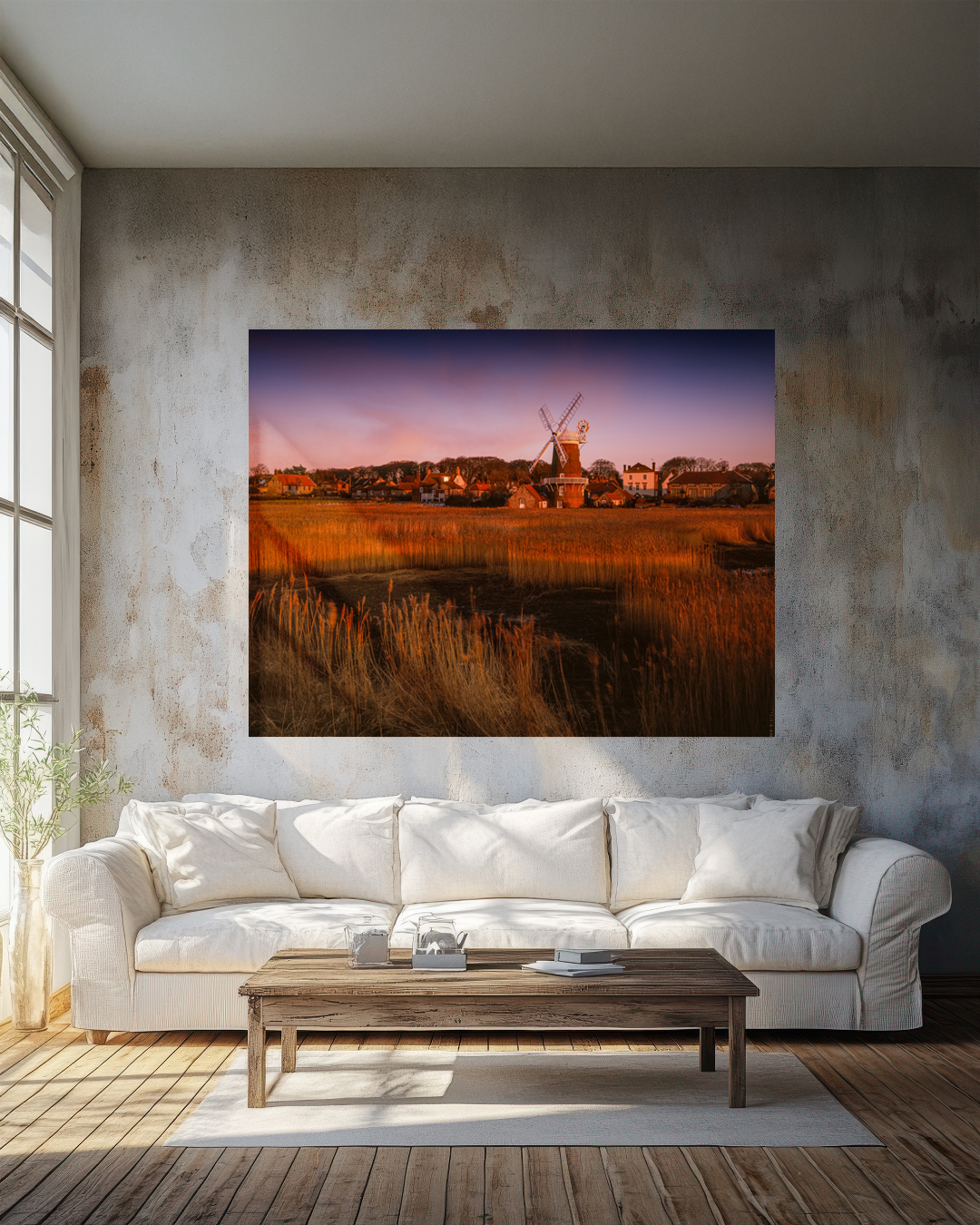
“The Last Light of Winter” Cley-next-the-Sea, Norfolk, England, UK is a contemporary image with traditional film roots.

Contact Rod Edwards for more details and for information regarding pricing.
Why this image became interactive
Some landscapes invite explanation. Others invite immersion. This image felt like the latter.
The interactive version of “The Last Light of Winter” allows viewers to move through the large format landscape photograph at their own pace, discovering detail and narrative gradually — much as I experienced the scene while standing there. The written elements and technical information tell the story behind the image and deepens understanding, without interrupting the visual experience.
▶ Explore the full interactive photograph here:
https://rodedwards.com/interactive-files/last-light-of-winter-cley-next-the-sea/
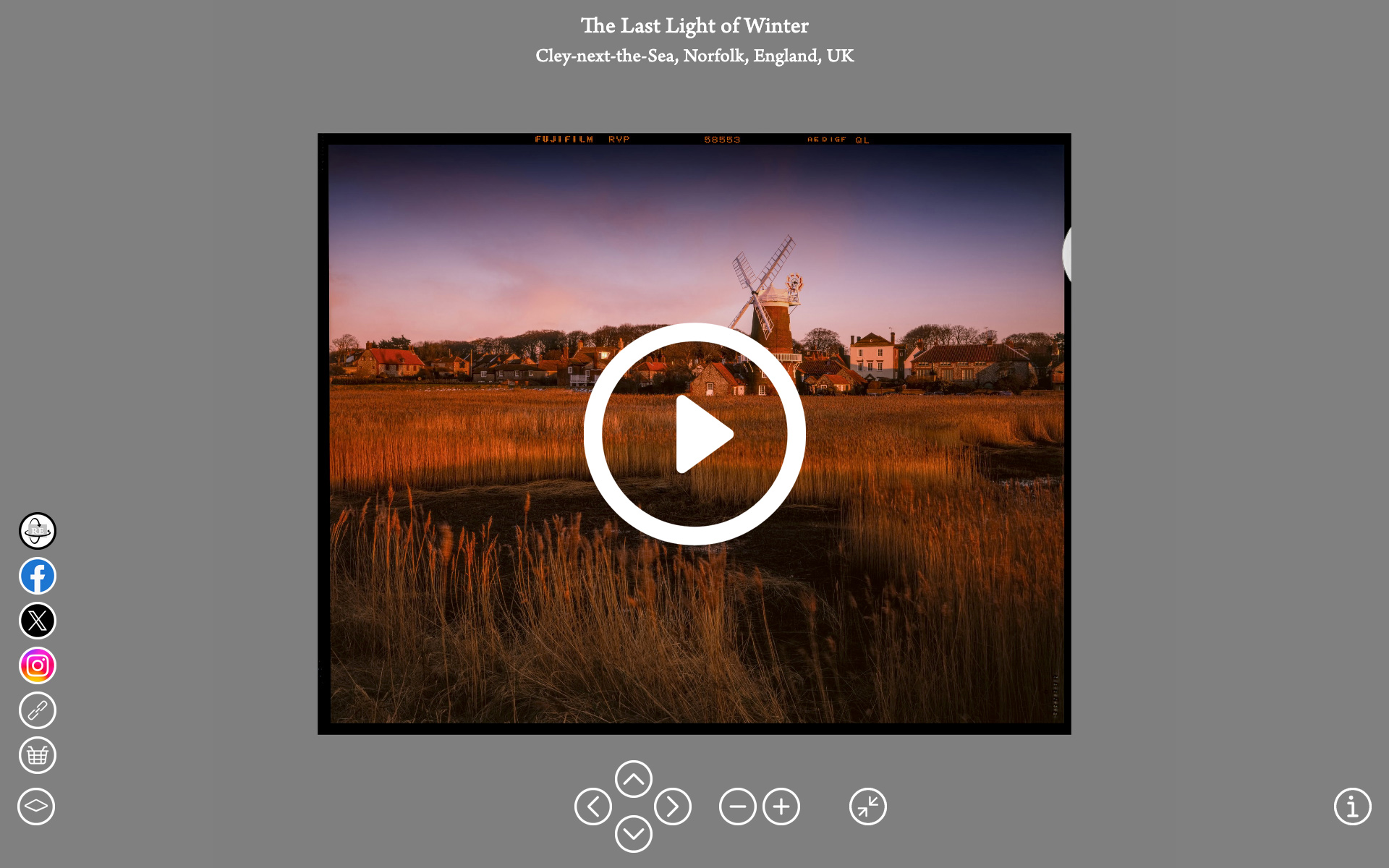
4×5 large format landscape photography. Click or tap to view interactive high resolution zoomable image.
Final thoughts
Cley-next-the-Sea is not a landscape that demands attention. It rewards it. In winter especially, its quietness becomes its defining strength — offering space for subtlety, balance, and reflection.
Photographed on large format 4×5 film and presented as both a fine art image and as an interactive work, “The Last Light of Winter” is an invitation to slow down, to look carefully, and to engage with the landscape on its own terms in your search for calm and contemplation.
Don’t forget to follow my social media platforms (links below) for more up to date news and topical features.
To view some of Places gallery click here.